
When two 500-kilogram bombs reduced the Donetsk Academic Regional Drama Theatre in Ukraine to rubble in March 2022, it wasn’t just a building that was lost—it was a community, a cultural beacon, and a sanctuary for over 1,200 civilians.
Against unimaginable odds, the actors who survived this atrocity have transformed their experiences into a documentary play, Mariupol Drama, a raw and deeply personal testament to resilience. This article traces the extraordinary journey of these artists—from their harrowing survival during the siege of Mariupol, to finding refuge in Uzhhorod, to bringing their story to the UK for the first time.
In this long-read, TheatreGB’s Robert Wallace and Ukrainian journalist Olha Danyliuk speak to the Mariupol Theatre Company, and British actor and producer David MacCreedy about their extraordinary collaboration. This is a story of survival, hope, and the unbreakable power of culture.
To read this story in Ukrainian, you can find this same article published on Volyn Gazeta. Click here to read.
THE CITY INSIDE A THEATRE
Before March 2022, the Donetsk Academic Regional Drama Theatre in Mariupol, Ukraine, stood as a beacon of the city’s rich artistic history.
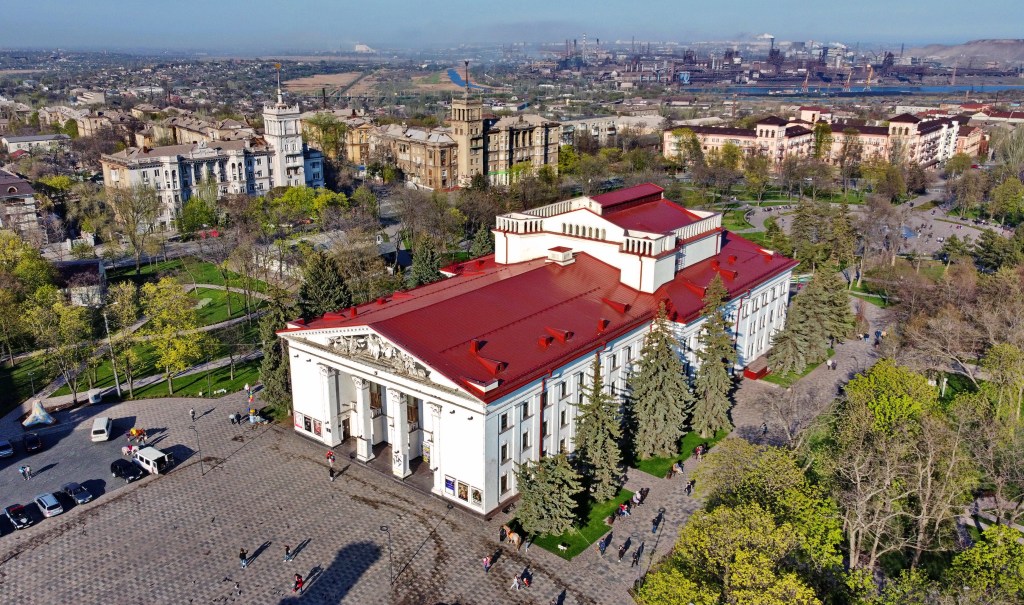
The theatre was a cultural landmark – its classical facade and striking red roof a testament to the city’s creativity and pride. Strategically positioned in the heart of Mariupol, on Teatral’na Square, the theatre was the centerpiece of Mariupol’s cultural and social identity. For decades, its stages hosted countless performances and festivals, drawing audiences from across the Donetsk region. But as the war in Ukraine unfolded, this proud symbol of creativity became something unimaginable: a lifeline for survival.
By March 2022, the theatre’s grand auditorium, corridors, and backstage areas had transformed into an overcrowded refuge for civilians fleeing relentless Russian airstrikes.
Located just 34 miles from the Russian border, Mariupol had become a primary target of aggression following the February full-scale invasion. Inside the theatre, over 1,200 civilians, including children, elderly people, and theatre staff, sought safety. It was a hub for distributing food, medicine, and water—the Donetsk Academic Regional Drama Theatre had become a city within a building.
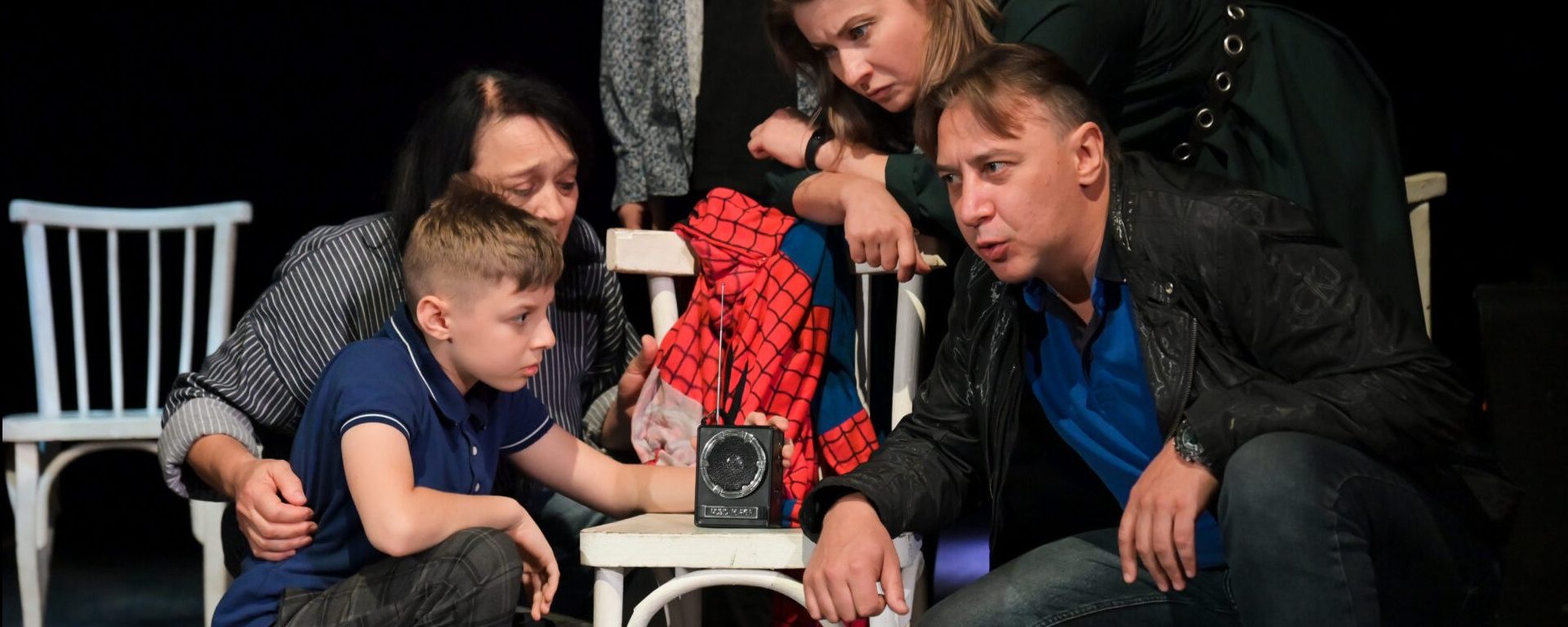
Among those seeking refuge were actors Olena Bila and Ihor Kytrysh, their 10-year-old son, Matvii, and the theatre’s head of music and drama, Vira Lebedynska.
For Olena, the theatre had been her second home for over 20 years, a place she had dedicated her life to. But now, as the air filled with the sound of planes and explosions, the building’s purpose shifted entirely. “We were completely cut off from information,” Olena recalls. “We didn’t know which areas or neighbourhoods were being bombed. The building could no longer be called a space for culture, education, or leisure—it had become a refuge.”
Inside, life became an exercise in survival. Families slept on stage decorations, mothers cared for newborns without access to milk or formula, and long lines formed for whatever food volunteers could provide. “I remember a chef who managed to make a seafood soup,” said Vira. “It tasted like heaven, especially when there was nothing else to eat.”
But the walls of the theatre could not shield them from the horrors outside. “Planes flew over every three minutes,” Vira recounts. “Back and forth from Azovstal, bombing, then returning. We hid on the steps while they flew overhead. It was terror, indescribable.”
Every day, they clung to the hope of a green corridor – a safe passage to escape – but it never came. “People who stayed in the theatre, despite everything, waited for help that never arrived,” Olena says.
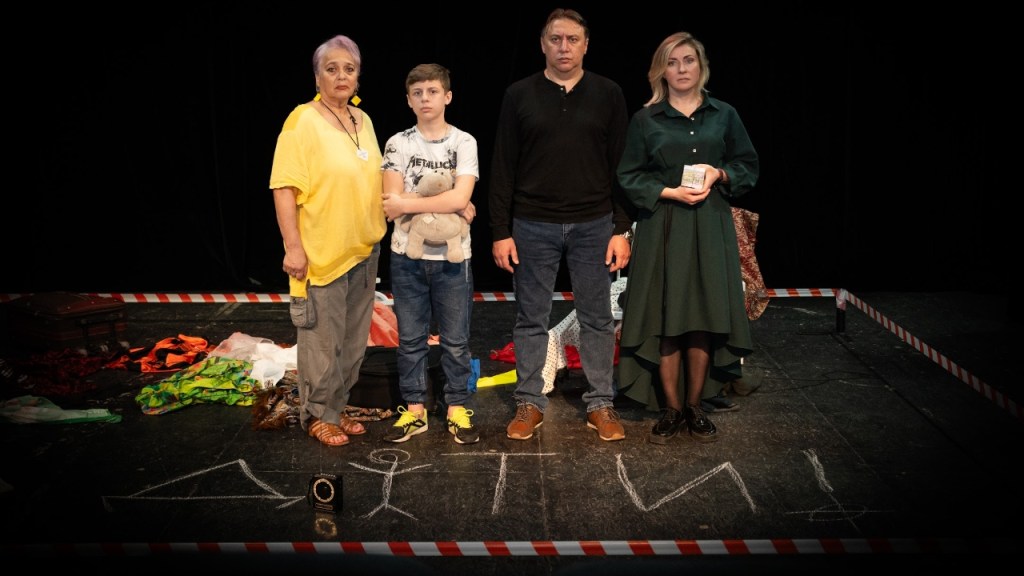
On the morning of March 16, 2022, at 10 a.m., two 500-kilogram bombs dropped from a Russian aircraft struck the theatre. The explosion collapsed the roof and much of the building’s walls. Hundreds of civilians were inside. Outside, the word “Дети” – “children” in Russian Cyrillic – had been painted in giant letters on both forecourts, a desperate plea for mercy visible from the skies. It was ignored. The theatre was destroyed in an instant.
Estimates of the death toll vary wildly, anywhere from at least a dozen to as many as 600. For survivors like Olena, Ihor, and their son Matvii, the tragedy is a permanent scar. Others, like Vira, stayed behind, bearing witness to unthinkable devastation.
The destruction of the Donetsk Academic Regional Drama Theatre was not just an attack on a building—it was an assault on a community, on humanity itself. Yet, these stories live on in the play Mariupol Drama, performed by the same actors who lived through it. “These small stories are collected in the play,” says Olena. “And through it, we will share the truth.”
TAMESIDE TO UKRAINE
At the same time as the Mariupol Theatre fell, 2,000 miles away in Tameside, Greater Manchester, local actor David MacCreedy was loading his car with shoeboxes stuffed with donations from his fellow Mancunians. MacCreedy was preparing for an almost 35-hour drive to the Ukrainian border. His destination: Romania, a country with which he has a deep personal connection.
In 1990, while studying drama at the Central School of Speech and Drama in London, MacCreedy had the chance to travel to Romania shortly after the Romanian Revolution. “I was lucky enough to go with Caryl Churchill,” he recalls, “and Caryl wrote a play about our experiences in Romania called Mad Forest.”
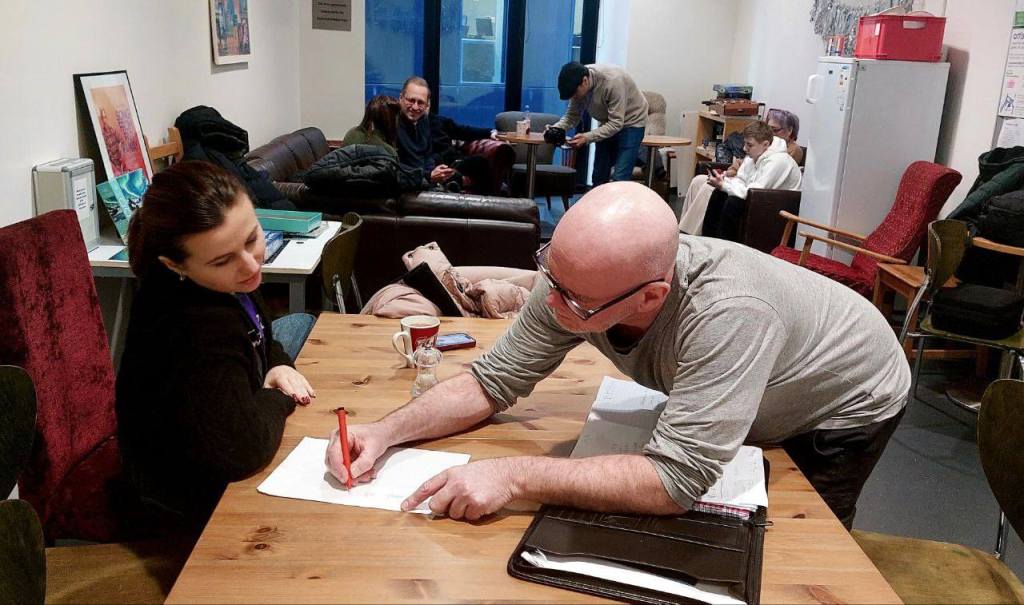
The visit came just a year after the fall of the Ceaușescu regime, at a time when political tensions were still high. MacCreedy and his cohort collaborated with Romanian drama students, staying with their families and immersing themselves in the culture. Upon his return to the UK, a dramatised version of their experience, Mad Forest, was staged to critical acclaim, ultimately transferring to the West End. But more than that, the experience left a lasting creative and personal impact on MacCreedy. He developed a keen interest in Eastern European theatre traditions and maintained close relationships with his Romanian friends, returning to the country at least once a year.
When Russia invaded Ukraine in February 2022, the conflict felt strikingly close to home for MacCreedy’s Romanian friends. “I started calling my friends in Bucharest to talk about it,” he says. “One of them, Constantin, told me, ‘We’re going to join up and fight.’ I asked, ‘What can I do? What can we do?’”
Determined to help, MacCreedy set up a Facebook group called Tameside2Ukraine, urging locals to donate essential items for families fleeing the war. Women and children made up the majority of those displaced, so MacCreedy focused on practical needs. “I asked people to imagine what you’d need if you were a woman fleeing your home,” he explains. “We filled shoe boxes with things like hair brushes, face wipes, and soap. Then me and another guy from Manchester set off to deliver them.”
That first journey to Eastern Europe was just the beginning. MacCreedy would go on to make multiple trips, initially delivering supplies to the border before crossing into Ukraine itself. He vividly recalls his first impressions in the summer of 2022: “Standing on the Romanian side of the Danube River, looking across into Ukraine. We got on a car ferry, and the feeling was surreal.”
His destination was Reni, a tiny city on Ukraine’s westernmost border, nestled along the Danube. There, he delivered critical aid to an orphanage. “It was red hot when we arrived. People were swimming in the river, kids were playing on the beach—but there were tank tracks in the sand. It was surreal, seeing people enjoying the sun while the visual signs of war were everywhere.”
“And then, in the evening, the air raid sirens started.”
THE THEATRE WITHOUT A ROOF
Following the attack on the theatre, the actors of the Mariupol Theatre Company became refugees within their own country.
Of the 200 theatre workers in Mariupol before the full-scale Russian invasion, only about 50 left Mariupol, joining various Ukrainian theatres or moving abroad. Olena, Ihor, Matvii, and Vira fled Mariupol and were among 14 of these people who eventually found refuge in Uzhhorod, a city in the far west of Ukraine. And there, something extraordinary unfolded.

In the expansive, unassuming auditorium of the Zakarpattia Regional Music and Drama Theatre, the displaced Donetsk Academic Regional Drama Theatre found a new home and a new purpose. The emotional wounds of what they endured remained raw. “It doesn’t go away,” Vira reflects. “You have to find a way to live with it.”
In Uzhhorod, renowned Ukrainian playwright Oleksandr Gavrosh proposed a remarkable idea: to transform their personal experiences into a play.
“He suggested that we express ourselves in the form of a personal confession,” says Olena. “He touched on various chords of our deepest feelings—from the circumstances of our birth, the environment in which we grew up, the region of the country, the upbringing we had, to how holidays were celebrated in our families. Every detail mattered to him.” He spoke with Olena for three days—more than seven hours in total. Overall, he conducted about 50 hours of interviews with members of the Mariupol Theatre Company.
“From these interviews, he selected stories about the drama theatre—about those who stayed there and those who left,” says Olena. “These stories were shaped into a literary work, which became the foundation of the play. Then a creative production team came together,” including director Yevhen Tyshchuk and designer Emma Zaitseva.
Olena continues: “The director’s main goal was for us not to act in the usual sense—not as actors who receive a script and embody someone else’s experience and story. In this production, it was deeply personal for each of us. We weren’t supposed to act; we had to be ourselves.”
Just six months after the attack on the Donetsk Academic Regional Drama Theatre, Mariupol Drama was staged for the first time to a full house.
A CHANCE ENCOUNTER
In early 2023, David MacCreedy was en route to Ukraine when he was invited to a theatre festival in Romania, where he saw the Mariupol Theatre Company perform for the first time. They performed another play, titled Cry of a Nation—and for David, the experience was nothing short of extraordinary.
“As actors do,” David recalls, he met Olena, Ihor, and Vira for drinks after the show. At the time, he had only a basic understanding of the attack on Mariupol. However, during the conversation, “it became a lot more pertinent where they were from.”
For David, this realisation made the meeting far more significant. “It wasn’t just, ‘Hey, should we get together and do something?’ It became, ‘Okay, you don’t have a theatre anymore. You’re refugees in your own country.’” The troupe responded with resilience: “We do have a theatre. We call it the theatre without a roof.”

Among the actors, Olena spoke the most English, and David was struck by “how keen she was to talk to British actors and learn about British theatre. After everything she’s been through—all the pain and suffering of this horrendous disaster—she was so positive, vibrant, and passionate about theatre. She was determined to bring their work to the UK.” Inspired by her enthusiasm, David was eager to help.
By September 2023, a few months after their first meeting, Olena sent the script of Mariupol Drama to David to get his thoughts. Without speaking Ukrainian, David “Google translated it, and it didn’t really make any sense.” Olena then sent a recording of the play, filmed on a mobile phone. “I totally got what the play looked like and how it sounded, but with the best will in the world, it’s still someone holding a mobile phone watching a play.” David resolved that he’d come to Uzhhorod and watch the play in person.
“When I watched it with a Ukrainian audience, it was just so amazing, so powerful, and so passionate, and I was so pleased that I made the decision to go over and watch it in their theatre—that I got to see it in their natural habitat.”
By the end of this performance, David was convinced. He took on a new mission: to bring Mariupol Drama to the UK.
FROM MARIUPOL TO MANCHESTER
First and foremost, David is an “actor by trade,” with Mariupol Drama being his first producing credit. And what a task he set himself—a transnational production involving actors and creatives in a country under martial law. “I didn’t have much hair to lose, but it’s all gone now,” jokes David.
Initially, David envisioned a low-key, fringe run for the show, carefully budgeting for a modest production. But a chance encounter with his old friend, Lisa Allen, former Head of Theatre at Manchester’s HOME, changed everything. “I wasn’t pitching to her,” David assures us. “But I was giving her all the information. At the end of it, she said, ‘We’ll have it at HOME.’ I thought, really? And she said, ‘Yeah, that sounds just the kind of thing that we’re into.’” Suddenly, Mariupol Drama had a venue, though the production was still “far from a done deal.”

Mounting a play is always expensive, and David began the daunting task of securing investment for the show. But serendipity struck again when he approached PW Productions in London, a company whose CEO, Ian Gillie, had worked with David on Mad Forest all those years ago. They were interested, but to secure the commitment, he needed to prove the production’s viability.
This led to a pivotal trip to Romania. David persuaded the Mariupol Company to cross the border to Romania and brought producers over from PW Productions to see the show. “And they came back and said, ‘Yeah, we’re very interested.’”
The next year was a whirlwind. “We’re just toing and froing with all the minutiae of paperwork and visas—in two different languages as well. We’re having discussions with HOME about when it was going to be on, what’s the best time of year, publicity, all the fun stuff, as I say.”
“And then, all of a sudden, we open tomorrow.”
AN ACT OF RESISTANCE
It’s January 2025, and performances of Mariupol Drama are now well underway at HOME.
Performing in Manchester adds a haunting resonance to the play. Like Mariupol, this is a city familiar with the scars of bombing, most recently the devastating attack on the Manchester Arena in 2017. “Manchester has its own history of facing difficult terrorist events, which left their mark on the lives of its people,” says Hennaddii Dybovski, the artistic director of the Mariupol Theatre Company, who has traveled to Manchester alongside the cast. “But life goes on, and they told us: ‘We will help you. We will tell your story. Believe that everything will be okay, and that good will inevitably triumph over evil.’”
David, who has lived in Manchester for the past 30 years, also felt a personal connection to bringing the play to the city. “I wanted the play to be in Manchester because I knew the people of Manchester would support it. I knew because when I started my little charity aid runs all that time ago, the support was immense.”
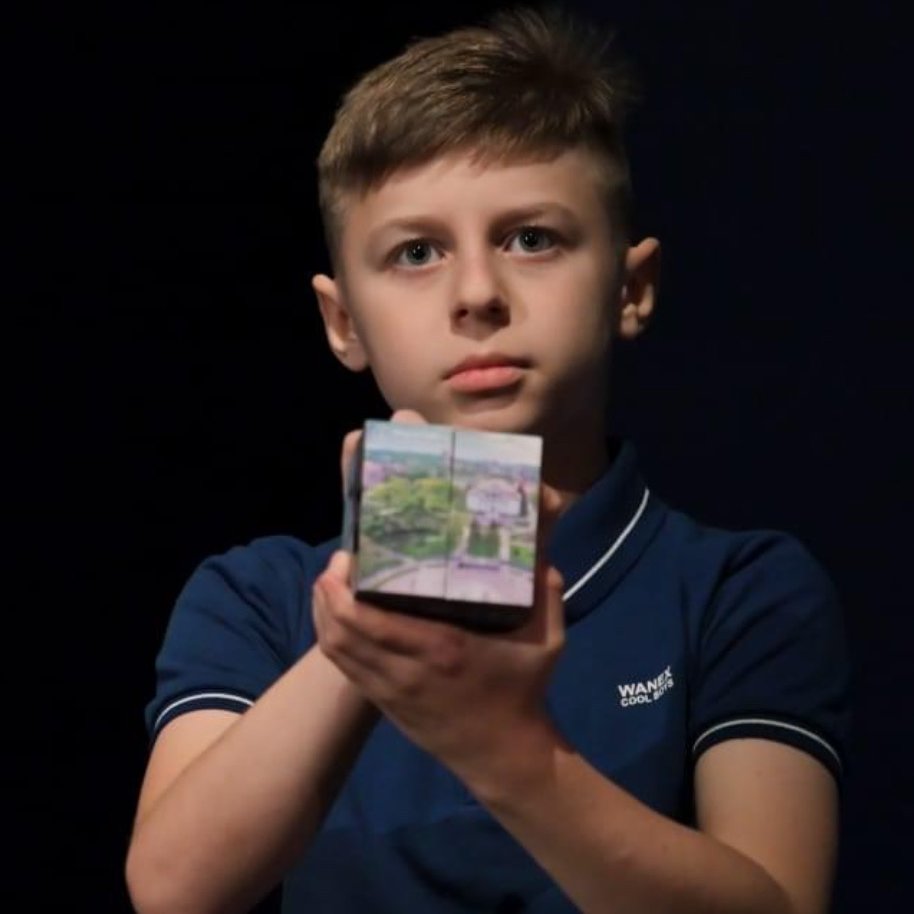
Almost three years on from Russia’s invasion of Ukraine, the timing of this production couldn’t be more crucial. While global attention has shifted and war fatigue has set in, Mariupol Drama is a powerful reminder of what happened that day in 2022.
For the cast, it’s not just a play—it’s a document of survival. “It’s important to tell the truth so people know that this was done by the Russians,” says Vira. “Propaganda is working, and they’ve started spreading the lie that it was the people inside the theatre who caused it.”
Today in Mariupol, history is literally being erased and rewritten. The Russian occupiers created a new local theatre, where plays only in the Russian language are performed.
Satellite imagery reveals a Potemkin-style facade built around the ruins of the Donetsk Academic Regional Theatre, disguising the site of the attack. According to Vira, they have even “concreted over the bodies of people in the theatre, erasing evidence of their destruction of the city.”
For Hennaddii, this production has a deeper purpose: “I often tell journalists that this play could be taken to The Hague. After the war, it could serve as testimony from people who lived through and witnessed these events. This is our primary mission: to feel supported, to believe in victory, and for the world to believe in victory too. We are strong. We are unbreakable.” For the company, the message is clear: no attack can destroy their culture.
David hopes Manchester audiences will embrace the courage of the cast and the urgency of their story. “I would really like it if people came and got a sense of the passion and bravery of these people who witnessed and survived a massacre. They have the strength to tell their story, and I’d like people to see it as a story worth telling.”
“You cannot kill us, you cannot kill our culture, you bombed our theatre, but we will go all over the world, and we will tell our story and we will tell it in our own language, Ukrainian.”
Though the Manchester run is just one week, both David and the Mariupol Theatre Company hope it will be a launchpad for future UK performances. It’s a historic moment for Ukrainian culture—Mariupol Drama is among the first Ukrainian-language productions to be performed in the UK since the onset of the war. More than a play, it’s a living document of their resilience.
“At this stage, we can say that for us, it has become a kind of psychological restoration—a catharsis,” says Olena. “It’s a dialogue where we can tell them about our experiences. We don’t want sympathy or pity. No, we want people to see that our theatre should not only be associated with its destruction by the Russians.”
“We want to say that theatre cannot be killed.”
Mariupol Drama runs at HOME, Manchester, until 18th January. Tickets are available here.
PHOTO CREDITS: Home Manchester; Donetsk Academic Regional Drama Theater, Mariupol – in Uzhhorod Facebook

 TheatreGB