

I’ll admit it – I had Unicorn pegged all wrong.
Maybe it was the title. Maybe it was the playful promotional branding. Maybe it was the fact that the cast is made up of three of Britain’s most recognisable TV actors, Whatever the reason, I went in suspecting something fun, flirty, and, dare I say it, maybe a little bit forgettable. A cheeky, contemporary British sex comedy with well-placed zingers and a generous helping of midlife-crisis-induced chaos.
Of course, that was my mistake. In the hands of a lesser writer, it might have been just that. But this is Mike Bartlett. And what we get instead is something far more interrogating.
Bartlett’s Unicorn begins in well-trodden territory: Nick and Polly, a middle-class couple in a midlife lull, decide to shake things up by inviting a younger third—Polly’s twentysomething student, Kate—into their relationship. What starts as a brisk, innuendo-laden romp quickly deepens into something unsettling, profound, and existential.
Beneath the laughs—and there are plenty—this is a play about ageing, repression, power, and fantasy. It’s about the lies we tell ourselves, the shifting nature of control in relationships, and whether we’re truly capable of honesty—not just with the people we love, but with ourselves.

Bartlett is a master at taking ideas that could be played for easy laughs and twisting them into something weightier, more uncomfortable. Here, the British sex comedy is the Trojan horse; inside is a play about identity, emotional repression, and the quiet terror of time slipping away.
All this to say: this isn’t just a play about sex. It’s a play about what we use sex to cover up.
Directed by the ever-reliable James Macdonald, Unicorn unfolds as a series of vignettes, a structure that suits Bartlett’s fast, daggering dialogue. There’s an immediate intimacy, a feeling that we’re eavesdropping rather than passively watching.
On Miriam Buether’s minimalistic set, a kaleidoscopic canopy constantly shifts and transforms. More than just an aesthetic choice, it reflects the play’s evolving emotional landscape. When two characters are on stage, the cloth lowers, cocooning them in intimacy. When all three share the space, it opens up, mirroring the expansion of their relationship.
The first half is brisk, clever, and laugh-out-loud funny, laced with classic British sexual awkwardness. Bartlett tips his hat to the great tradition of British sex farce—both celebrating and subverting the form—but just when you think you know where it’s going, the play transcends the genre entirely.

The humour is the gateway drug—but what follows is something almost Chekhovian in its depth and melancholy. Themes of ageing, boredom, fantasy, and the gnawing presence of mortality creep in.
The second act risks a time jump and a stark tonal change, pushing the play from character-driven comedy into something grander, more outward-facing. Bartlett widens the lens beyond the bedroom—quite literally, to the apocalyptic world we are hurtling towards. It’s an ambitious move that doesn’t entirely land, but you have to admire the reach.
The fact that Unicorn is explicitly set in 2025 is no accident. Bartlett’s interpretation captures the cultural moment, clinically examining the evolving landscape of relationships, gender dynamics and social expectations in our world.
In Unicorn, Bartlett seems to be making a case for polyamory as the next great social revolution—a response to the failures of monogamy, a blueprint for the future of love and commitment. It’s provocative, but also a little too neat. The play, for all its emotional complexity, doesn’t offer enough of the expected resistance to polyamory as a concept. Bartlett’s characters explicitly tell us this is the brave new frontier, but it unfolds with surprisingly little external pushback from the world outside the stage.

Where the play occasionally falters, its lifted by a cast truly at the top of their game. Stephen Mangan wears the role like a glove – his blend of naturalism and insecurity puts him as the perfect foil in the play’s shifting dynamics. Likewise, Nicola Walker’s Polly is both quietly affecting and deeply funny – she gives the role a lived-in quality that makes her choices feel inevitable and invisible.
Erin Doherty is the standout. Sharp, watchable, and utterly unpredictable, she commands every scene with a mix of wisdom and raw energy. As Kate, she is the catalyst—spiky, disruptive, and impossible to ignore. A sledgehammer to the couple’s repression, she shatters their carefully managed illusions of stability, forcing them to confront the truths they’d rather avoid.
One of the play’s most compelling tensions is its exploration of power dynamics. Bartlett constantly shifts the balance, ensuring that we never settle into a clear understanding of who holds control in the relationship.
At first, it seems like Kate, the archetypal unicorn (a term in polyamory for a woman who joins a couple’s relationship), is in the dominant position. The couple audition her, trying to shape their fantasy around her presence.
Polly also exerts agency—she’s the instigator, the one who maintains separate relationships with both partners and brings them together.
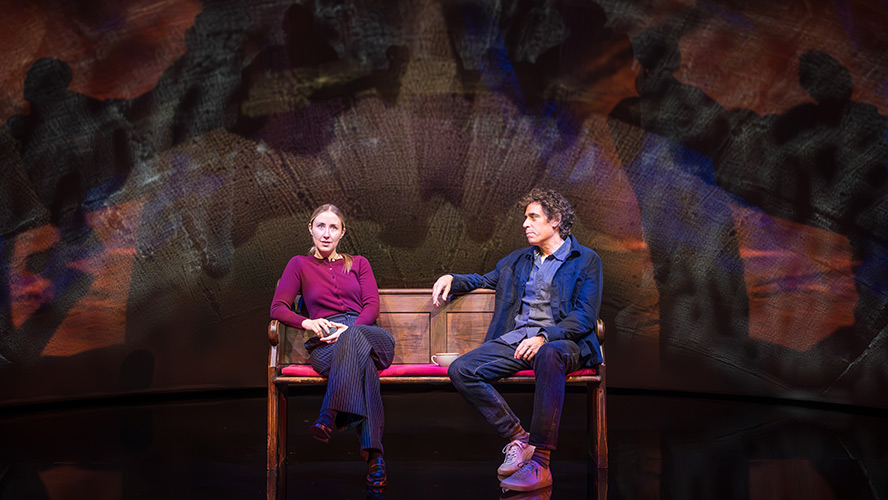
Meanwhile, Nick reckons with his masculinity. There’s an undeniable undercurrent of male fragility, which Mangan plays to perfection—a tension between the way he performs power and the reality of his increasingly unstable position. Bartlett lays the groundwork for something more primal, more violent beneath his affable, middle-class exterior.
Then there’s the issue of honesty. “Sex is sex, it’s lying that’s the fucking crime” says Kate. This is a play that gets under the skin of its characters, exposing their unspoken resentments, contradictions, and the compromises they make to sustain their illusions. What we say and what we mean are often at odds, and Bartlett lets those gaps widen until they can’t be ignored.
Unicorn is, at its core, a play about assumptions—ours, its characters’, and society’s. I assumed I knew what this play would be. Just as we assume we understand love, control, and the shape relationships should take. But Bartlett dismantles those certainties, exposing the contradictions, power struggles, and unspoken fears beneath them.
Audiences may arrive with their own assumptions about polyamory—who holds power, how it works, why it fails. Unicorn doesn’t offer easy answers, but it does challenge the idea that relationships fit into neat, predefined boxes.
For a play built on the foundations of a sex comedy, its ideas about love are far more provocative. It might leave the pearl-clutching matinee crowd squirming, but that’s exactly the point. Strip away assumptions, and what’s left is far messier—and far more interesting.
RATING: ★★★★
Unicorn runs at the Garrick Theatre to April 26th. Tickets are on sale here.

 TheatreGB